
🪶 A — Align Perspectives
Redefine success. Honour effort. Protect dignity.
Once myths fall away and emotional storms are held with steadiness, a deeper question remains:
If ADHD really works like this… how do we learn to see the same situation differently — together?
Aligning perspectives is where understanding becomes relational wisdom.
It is not about expecting less.
It is about learning to stand somewhere else long enough to see what you could not see before.
When perspectives are misaligned, even loving relationships strain. Effort goes unseen. Intent is misread. Shame accumulates quietly — not because anyone means harm, but because people are looking at the same problem from different ground.
This page is about learning how to find common ground.

👁️ When Views Collide
Why disagreement feels so hard — and why compromise often fails
Standing on different hills doesn’t just shape what we see.
It shapes what we defend.
When two people disagree, it often feels as though one of three things must happen:
- one person gives in
- the other person pushes harder
- or both meet somewhere in the middle and settle
This is the traditional model of compromise.
But compromise often means one person climbing down from their hill — or dragging the other across — even when neither truly understands the other’s view. Both may lose something important. Both may walk away with a quiet sense of bitterness.
Compromise can look fair on the surface, yet still feel wrong underneath.
Especially in ADHD relationships, compromise often fails because the disagreement isn’t really about the thing being argued over.
It’s about what that thing represents.
🏔️🏔️The Two Hills
Why perspective matters before problem-solving
Imagine two people standing on different hills, looking down at the same issue in the valley between them.
From each hill, the view is real — but partial.
One hill represents a neurotypical perspective:
- linear time
- visible productivity
- consistency as a sign of effort
- regulation before difficulty
The other hill represents a neurodivergent perspective:
- fluctuating capacity
- invisible effort
- recovery after overwhelm
- regulation that arrives later, not earlier
The issue in the valley might be the same — a messy kitchen, a missed deadline, an emotional outburst — but what each person sees is shaped by where they stand.
Traditionally, pressure is placed on the neurodivergent person to climb the neurotypical hill and “see it properly”.
Alignment asks something different.
It asks loved ones to also step onto the other hill — not permanently, not at the expense of their own needs — but long enough to understand the full shape of the problem.
Alignment doesn’t abandon one perspective.
It widens the field of view.

🪶 A — Align Perspectives
Redefine success. Honour effort. Protect dignity.
Once myths fall away and emotional storms are held with steadiness, a deeper question remains:
If ADHD really works like this… how do we learn to see the same situation differently — together?
Aligning perspectives is where understanding becomes relational wisdom.
It is not about expecting less.
It is about learning to stand somewhere else long enough to see what you could not see before.
When perspectives are misaligned, even loving relationships strain. Effort goes unseen. Intent is misread. Shame accumulates quietly — not because anyone means harm, but because people are looking at the same problem from different ground.
This page is about learning how to find common ground.
🏔️🏔️The Two Hills
Why perspective matters before problem-solving
Imagine two people standing on different hills, looking down at the same issue in the valley between them.
From each hill, the view is real — but partial.
One hill represents a neurotypical perspective:
- linear time
- visible productivity
- consistency as a sign of effort
- regulation before difficulty
The other hill represents a neurodivergent perspective:
- fluctuating capacity
- invisible effort
- recovery after overwhelm
- regulation that arrives later, not earlier
The issue in the valley might be the same — a messy kitchen, a missed deadline, an emotional outburst — but what each person sees is shaped by where they stand.
Traditionally, pressure is placed on the neurodivergent person to climb the neurotypical hill and “see it properly”.
Alignment asks something different.
It asks loved ones to also step onto the other hill — not permanently, not at the expense of their own needs — but long enough to understand the full shape of the problem.
Alignment doesn’t abandon one perspective.
It widens the field of view.
👁️ When Views Collide
Why disagreement feels so hard — and why compromise often fails
Standing on different hills doesn’t just shape what we see.
It shapes what we defend.
When two people disagree, it often feels as though one of three things must happen:
- one person gives in
- the other person pushes harder
- or both meet somewhere in the middle and settle
This is the traditional model of compromise.
But compromise often means one person climbing down from their hill — or dragging the other across — even when neither truly understands the other’s view. Both may lose something important. Both may walk away with a quiet sense of bitterness.
Compromise can look fair on the surface, yet still feel wrong underneath.
Especially in ADHD relationships, compromise often fails because the disagreement isn’t really about the thing being argued over.
It’s about what that thing represents.
🌀 From Dissonance to Resonance
So, standing on different hills doesn’t just shape what we see.
It shapes what we argue for.
When disagreement arises, the experience is often one of dissonance — tension, friction, a sense of being out of sync. Each person is responding honestly from their vantage point, yet the more firmly they defend it, the further apart they feel.
Dissonance doesn’t mean people want different outcomes.
It usually means they are seeing different parts of the same picture.
Resonance doesn’t come from winning the argument.
It comes from aligning perspective.

🏔️🏔️ The Two Hills in Disagreement
Imagine again the two hills — this time with a practical example of a disagreement.
A home example: the colour of the kitchen
Two people stand on opposite hills, looking down at the same kitchen renovation.
- From one hill, the view highlights practicality, calm, and order.
- From the other, the view highlights creativity, energy, and warmth.
From one side:
“That colour will make the space feel chaotic.”
From the other:
“That colour will make the space feel alive.”
The disagreement sounds like it’s about paint.
It isn’t.
Both people want the same thing:
- a home that feels good to live in
- a shared space they can enjoy together
But if the conversation stays on the hills — fixed at the level of positions that have been taken up — the result is often a compromise that satisfies neither. A colour chosen not because it feels right, but because it offends least.
The disagreement isn’t resolved.
It’s simply flattened.
Dissonance remains — just quieter.

🫶 ALIGN
ALIGN offers a different movement.
Not sideways.
Not uphill.
But downward.
Instead of asking:
“Whose view is right?”
ALIGN asks:
“What are we each actually trying to protect?”
To answer that, neither person crosses to the other’s hill yet.
First, both must come down from their own into the valley of needs.

🏔️ Coming Down the Hill
Understanding yourself before understanding the other
From the top of a hill, we tend to use a telephoto lens.
We see sharply — but narrowly. Only what our position allows. Coming down into the valley requires a shift to a wide-angle lens as you get closer to the need that results in the position one has taken up. This is where alignment begins. Before trying to understand the other person, ALIGN invites you to ask:
- What matters to me here?
- What am I trying to protect?
- What need is sitting underneath my position?
If we are not clear about our own interests and needs, we cannot truly see the other person’s. We remain reactive, defending a position rather than understanding what’s beneath it. This is the first act of alignment: knowing yourself clearly enough to loosen your grip on being right.
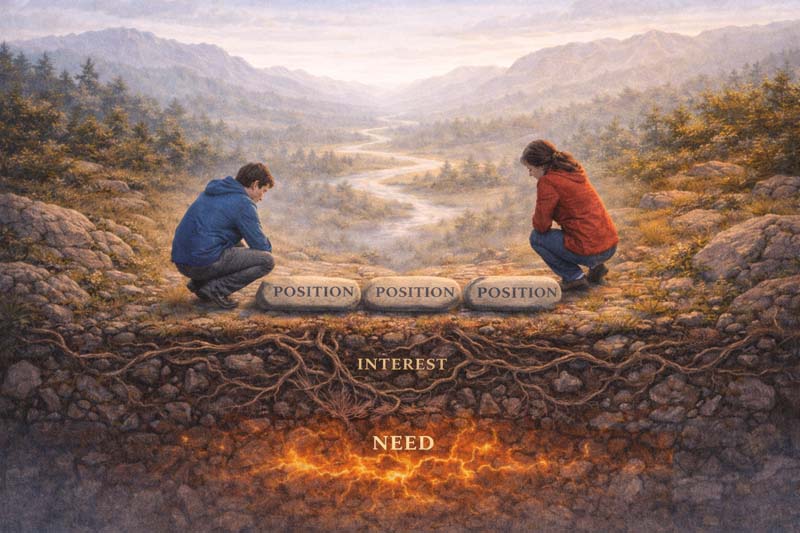
👉 Pinning It Down
From position to interest to need
Once both people step into the valley, the conversation can deepen.
This is where we pin it down.
When disagreement arises, ALIGN invites us to move through three layers:
- Position — what we’re arguing about
- Interest — why it matters to each of us
- Need — what both of us ultimately require
This is the PIN process.
We don’t pin down the argument.
We pin down the need.

🚶♀️🚶♂️Walking Around the Issue
Seeing the whole shape
Once in the valley of needs, you can walk around the issue.
You can see how it looks from different angles, in different light.
Only then does the next movement make sense.

🌄 Climbing the Other Hill
Understanding how their view came to be
With your own needs pinned down, you can now climb the other person’s hill — not to agree, but to understand.
From there, you begin to see:
- their interest
- the need driving it
- how their position formed naturally from their view
This is where resonance begins.
You can return to your own hill if you choose.
Or you can stand together in the valley.
But given you are aware of your and the others interests and needs, the discussion now happens not on opposing peaks, but on shared ground. The reality is that despite the depth of the disagreement and the distance between the divergent views, more often than not there is common ground at the level of needs.

💞 In ADHD Relationships
In ADHD relationships, dissonance often arises not because people care less — but because they are standing on different hills shaped by different nervous systems.
ALIGN teaches loved ones how to:
- move out of positional conflict
- understand themselves before correcting others
- find shared needs beneath visible differences
That is how dissonance softens into resonance.
Not by compromise that leaves residue —
but by alignment that creates understanding.
Applying PIN to ADHD Relationships
Respect, contribution, and feeling valued
In ADHD relationships, many disagreements sit on this fault line.
At the level of position:
- “You’re not pulling your weight.”
- “I am trying, it’s just not enough for you.”
At the level of interest:
- The neurotypical person may be seeking responsibility
(shared load, predictability, fairness) - The neurodivergent person may be seeking contribution
(having their effort recognised, being allowed to contribute in their way)
Different interests.
But not opposing ones.
At the level of need:
Both are often trying to meet the same need:
To feel respected.
To feel valued in the relationship.
When contribution isn’t recognised, the neurodivergent person feels diminished.
When responsibility feels uneven, the neurotypical person feels unseen.
Both experience disrespect — just from different hills.
Alignment begins when that shared need is named.

⏱️ In the Work Context
different paths to the same outcome
The same pattern appears at work.
Two colleagues want a project to succeed.
- One values structure, timelines, predictability.
- The other brings creativity, intensity, bursts of innovation.
At the surface, they disagree about how the work is done.
Underneath, both want:
- to be taken seriously
- to have their contribution respected
- to feel trusted as professionals
If they argue only about process, frustration grows.
If they pin down the shared need — respect and impact — common ground appears.
💖 Why this matters for HEART
ALIGN is not about avoiding disagreement.
It is about navigating it wisely.
By staying curious long enough to dig beneath positions, loved ones learn to:
- stop personalising differences
- reduce shame and defensiveness
- respond to needs rather than react to positions
That is how expectations align.
Not by compromise that leaves residue,
but by understanding that brings people onto shared ground.
🌿 From Understanding to Alignment
Why ALIGN becomes possible now
By this point in HEART, something important has already happened.
Loved ones have:
- Learned to hold space, reducing emotional escalation and reactivity
- Expanded their understanding, letting go of damaging myths about ADHD
Because of this, alignment is no longer a theoretical ideal.
It becomes possible.
When space is held, conversations slow down enough to deepen.
When myths are dismantled, behaviour is no longer mislabelled as laziness or lack of care.
Only then can people begin to move from dissonance to resonance.
ALIGN is not a standalone skill.
It is what becomes available after understanding and steadiness are in place.


🚶♀️🚶♂️ALIGN as a Movement
From the hills, through the valley, and back again
ALIGN is not about convincing, conceding, or compromising.
It is a movement of perspective.
- From the hill (where views are partial and defended)
- Down into the valley (where needs can be pinned down)
- Around the issue (seeing its full shape)
- And, when helpful, up the other person’s hill (to understand how their view formed)
This movement transforms disagreement from a battle of positions into an exploration of meaning.
ALIGN works because it insists on one essential sequence:
Understand yourself → then understand the other → then respond.
🌿 From Understanding to Alignment
Why ALIGN becomes possible now
By this point in HEART, something important has already happened.
Loved ones have:
- Learned to hold space, reducing emotional escalation and reactivity
- Expanded their understanding, letting go of damaging myths about ADHD
Because of this, alignment is no longer a theoretical ideal.
It becomes possible.
When space is held, conversations slow down enough to deepen.
When myths are dismantled, behaviour is no longer mislabelled as laziness or lack of care.
Only then can people begin to move from dissonance to resonance.
ALIGN is not a standalone skill.
It is what becomes available after understanding and steadiness are in place.
🌿 ALIGN as a Movement
From the hills, through the valley, and back again
ALIGN is not about convincing, conceding, or compromising.
It is a movement of perspective.
- From the hill (where views are partial and defended)
- Down into the valley (where needs can be pinned down)
- Around the issue (seeing its full shape)
- And, when helpful, up the other person’s hill (to understand how their view formed)
This movement transforms disagreement from a battle of positions into an exploration of meaning.
ALIGN works because it insists on one essential sequence:
Understand yourself → then understand the other → then respond.
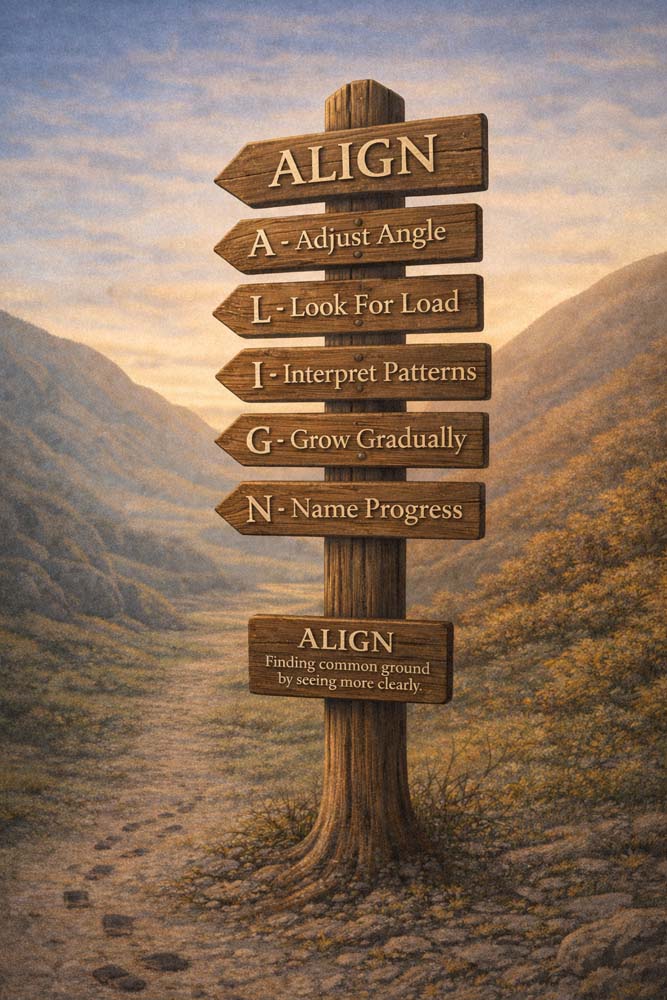
🧭 ALIGN in Practice
How aligned perspectives are sustained over time
Once perspectives have been widened and needs have been pinned down, alignment doesn’t happen once and disappear.
It becomes a practice — one that holds even when life stays uneven, emotional, or unfinished.
ALIGN offers a way of staying oriented to each other over time.
Not by agreement at every turn, but by returning — again and again — to the valley where understanding lives.

📐 A — Adjust Angle
Change the angle, change the lens, not the person
From the top of our own hill, the view is sharp and convincing.
We see behaviour clearly — but narrowly. Like a telephoto lens, it magnifies detail while flattening context.
Adjusting angle means stepping down from height and changing how we look.
It involves:
- shifting from judgement to context
- widening the frame beyond a single moment
- separating impact from intention
This is where positions begin to soften.
What once looked like resistance may begin to look like overload.
What felt like indifference may reveal itself as depletion.
Adjusting angle does not excuse harm.
It prevents distortion.
Aligned perspective:
This looks straightforward from where I stand — but not from where they are standing.

👀 L — Look For Load
Dig deeper than outcomes
Once the angle widens, the next step is depth.
In ADHD, much of the real work happens below the surface.
Effort is often internal, exhausting, and invisible — especially when outcomes don’t match the cost.
Looking for load means noticing:
- what it takes, not just what it produces
- persistence beneath inconsistency
- re-engagement after setbacks
This is the beginning of the descent from position into interest.
Instead of arguing about what should have happened, we start to ask:
What was this asking of them?
When load is seen, people feel valued.
When it is missed, shame quietly accumulates.
Aligned perspective:
Effort is a form of contribution — even when results fall short.

🔎 I — Interpret Patterns
See the shape over time
Single moments mislead.
Patterns teach.
Interpreting patterns means lifting your gaze from the episode to the arc — from the storm to the weather system.
This includes noticing:
- cycles of energy and depletion
- recurring triggers and recovery points
- what improves slowly, rather than instantly
This is where we move from interest toward need.
Not just why this mattered today, but what keeps showing up underneath.
Patterns often reveal shared needs long before people can name them:
- safety
- dignity
- contribution
- being valued
Aligned perspective:
This isn’t a one-off problem — it’s a pattern asking to be understood.

🌱 G — Grow Gradually
Give alignment time
Once needs begin to surface, alignment must be given room to mature.
Growth — in skills, understanding, and trust — is rarely immediate.
In ADHD relationships especially, change consolidates unevenly.
Growing gradually means:
- widening capacity before increasing demand
- letting insight stabilise before expecting consistency
- building shared ground strong enough to hold difference
This is not lowering expectations.
It is sequencing them wisely.
Alignment fails when it is rushed.
It holds when it is cultivated.
Aligned perspective:
Lasting change grows — it doesn’t leap.

❤️🩹 N — Name Progress
Nurture what’s working
What we name becomes real.
What we repeatedly name begins to grow. In many relationships, attention drifts naturally toward what is still hard. Naming progress restores balance.
This includes noticing:
- earlier awareness
- smaller escalations
- quicker repair
- attempts to do things differently
Progress does not erase difficulty.
It prevents the story from becoming one-dimensional.
When progress is named, hope strengthens.
When it is ignored, effort withers.
Aligned perspective:
I see what’s changing — not only what’s unfinished.
A Quiet Anchor for Loved Ones
We don’t need to stand on the same hill.
We don’t need identical views.
What we need is the willingness to come down,
to dig beneath positions,
to pin down shared needs,
and to walk the ground together before climbing again.
That is how dissonance turns into resonance.
That is what aligned perspectives make possible.
Mon - Fri: 8AM - 6PM
Sat - Sun: Variable
Brisbane North Medical Specialists,
15 Dallas Parade, Keperra, QLD 4054
(07) 5221 3489
reception@bnms.com.au