
🧭 SPACE
🌿Instil Calm, Rise Strong
FLOURISH and HEART are designed as companion journeys.
FLOURISH is for people living with ADHD.
HEART is for the people who walk alongside them — partners, parents, children, siblings, friends, teachers, and colleagues.
They are not the same path. But they are meant to be walked together.
In FLOURISH, the I stands for Instil — Instil Calm, Rise Strong.
This is where people with ADHD learn how to steady their own nervous system when emotions surge, impulses spike, or overwhelm takes hold. Through the RISE CALMly framework, they are taught to understand the wildfire mind — a brain that is fast, creative, powerful, and emotionally intense — and to build body-based and reflective skills that help them calm the storm before it causes harm.
This work is deeply personal. It happens inside the person with ADHD. In HEART, the parallel skill is H — Hold Space. Where Instil Calm is an inside-out skill, Hold Space is an outside-in one.
HEART is not about managing ADHD for someone else, and it is not about turning loved ones into therapists. It is about learning how to shape the relational environment so that the skills being learned in FLOURISH have room to emerge, be practised, and take hold.
Because ADHD does not live in isolation. When someone with ADHD is overwhelmed, dysregulated, or emotionally flooded, the storm rarely stays contained. Partners, parents, children, friends, colleagues, teachers — all can find themselves pulled into the emotional weather system, sometimes without warning.
In those moments, what you do — and just as importantly, how you are — matters. You are not expected to calm someone for them. But your presence can either support the return to calm or unintentionally make it harder to reach.
That is why HEART offers its own companion framework.
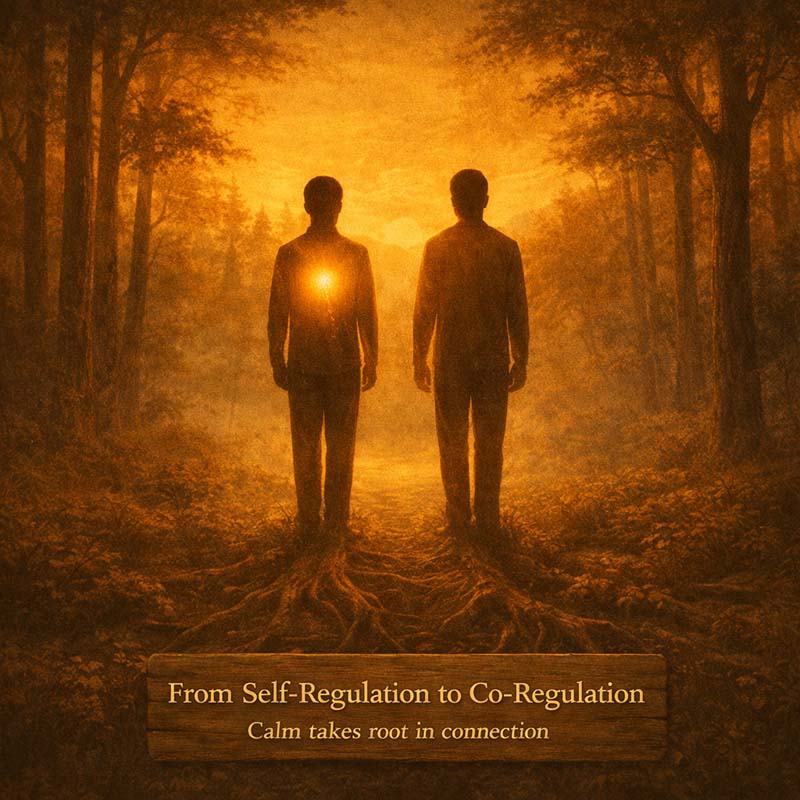
🌟 To Co-Regulation
To understand how holding space works, it helps to briefly understand the self-regulation skills people with ADHD are learning — and how those skills translate into co-regulation in relationships.
RISE CALMly teaches people with ADHD how to:
- Calm the body when emotions spike
- Recognise and understand emotional surges
- Choose responses rather than react impulsively
- Learn from moments of overwhelm
When you understand this, something important shifts.
You stop asking:
“Why can’t they just calm down?”
And start asking:
“What helps calm take root?”
That is where holding space comes in.
Holding space is not fixing.
It is not correcting.
It is not walking on eggshells.
Holding space is becoming a steadier nervous system in the room, long enough for the other person’s system to settle and re-engage.
To make this practical, HEART uses a companion framework — one designed specifically for loved ones.
🧭 SPACE
🌿Instil Calm, Rise Strong
FLOURISH and HEART are designed as companion journeys.
FLOURISH is for people living with ADHD.
HEART is for the people who walk alongside them — partners, parents, children, siblings, friends, teachers, and colleagues.
They are not the same path. But they are meant to be walked together.
In FLOURISH, the I stands for Instil — Instil Calm, Rise Strong.
This is where people with ADHD learn how to steady their own nervous system when emotions surge, impulses spike, or overwhelm takes hold. Through the RISE CALMly framework, they are taught to understand the wildfire mind — a brain that is fast, creative, powerful, and emotionally intense — and to build body-based and reflective skills that help them calm the storm before it causes harm.
This work is deeply personal. It happens inside the person with ADHD. In HEART, the parallel skill is H — Hold Space. Where Instil Calm is an inside-out skill, Hold Space is an outside-in one.
HEART is not about managing ADHD for someone else, and it is not about turning loved ones into therapists. It is about learning how to shape the relational environment so that the skills being learned in FLOURISH have room to emerge, be practised, and take hold.
Because ADHD does not live in isolation. When someone with ADHD is overwhelmed, dysregulated, or emotionally flooded, the storm rarely stays contained. Partners, parents, children, friends, colleagues, teachers — all can find themselves pulled into the emotional weather system, sometimes without warning.
In those moments, what you do — and just as importantly, how you are — matters. You are not expected to calm someone for them. But your presence can either support the return to calm or unintentionally make it harder to reach.
That is why HEART offers its own companion framework.
🌟 To Co-Regulation
To understand how holding space works, it helps to briefly understand the self-regulation skills people with ADHD are learning — and how those skills translate into co-regulation in relationships.
RISE CALMly teaches people with ADHD how to:
- Calm the body when emotions spike
- Recognise and understand emotional surges
- Choose responses rather than react impulsively
- Learn from moments of overwhelm
When you understand this, something important shifts.
You stop asking:
“Why can’t they just calm down?”
And start asking:
“What helps calm take root?”
That is where holding space comes in.
Holding space is not fixing.
It is not correcting.
It is not walking on eggshells.
Holding space is becoming a steadier nervous system in the room, long enough for the other person’s system to settle and re-engage.
To make this practical, HEART uses a companion framework — one designed specifically for loved ones.
🌀 Hold SPACE
When emotions rise, remember SPACE.
Not to control the moment — but to create the conditions in which calm can return.
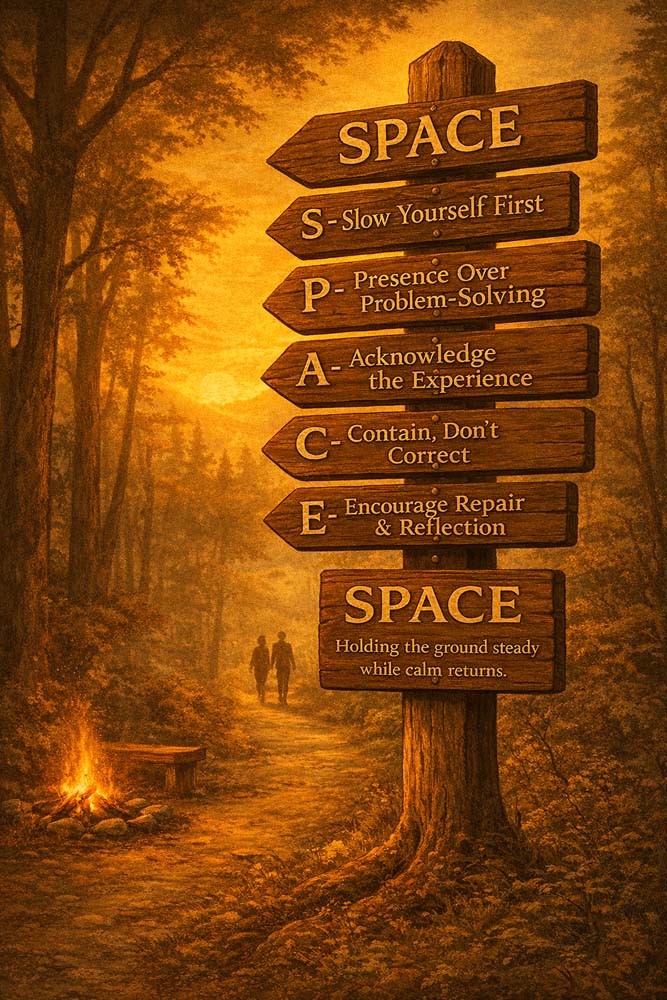
Just as people with ADHD are taught Instil Calm, Rise Strong, those who support them are offered SPACE — a practical, humane way of holding space through co-regulation. SPACE does not replace RISE CALMly; it works alongside it, helping loved ones recognise what skills are being practised and how to gently support their use in real life. This page is about learning how to do exactly that. 🌿

🐢 S — Slow Yourself First
Before you say anything, slow your body.
This is not a courtesy step. It is the foundation. When someone with ADHD is overwhelmed, their nervous system is already running fast and hot. Emotional intensity is high, cognitive flexibility is low, and the thinking brain is partially offline. In this state, content doesn’t land. Logic bounces off. Even well-chosen words can feel intrusive or critical. What reaches them first is pace. Slowing yourself first is how you signal safety without speaking. Your body becomes the message.
How to slow your body
- Lower your voice slightly below your usual register
- Breathe out longer than you breathe in
- Drop your shoulders and unclench your jaw
- Soften your face — especially around the eyes
These are not techniques to look calm. They are ways to become calm.
The nervous system responds to pace before it responds to meaning.
If your body is hurried, your words will be heard as pressure — even if they are kind.
What helps
- Pausing before responding, even for a few seconds
- Allowing silence to do some of the work
- Speaking less, not more
Silence, when it is steady, creates room for regulation to begin.
What doesn’t
- Matching their intensity
- Talking faster to “get through it”
- Rushing to explain, justify, or defend yourself
Speed, even when well-intentioned, often escalates rather than soothes.
Quiet reframe
If I slow down, the moment has somewhere to land.
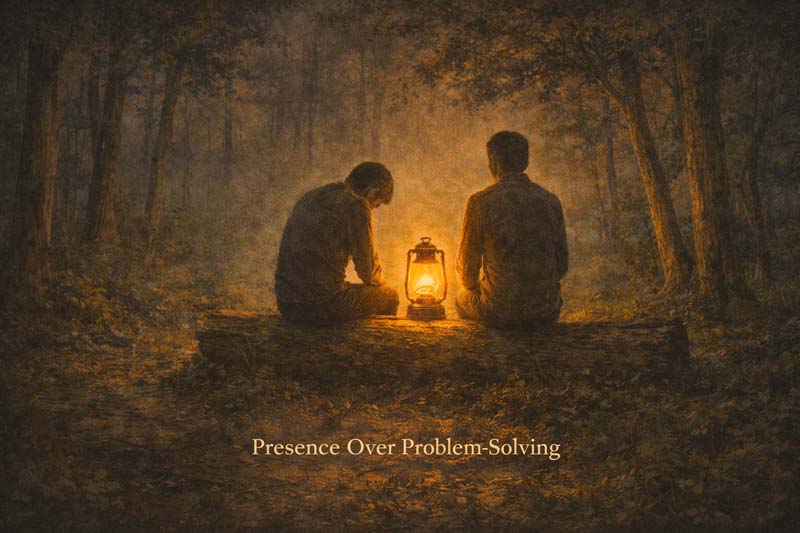
🤝 P — Presence Over Problem-Solving
In moments of overwhelm, solutions feel like demands.
When the brain is flooded, even good ideas can sound like criticism. The thinking mind simply isn’t online yet — so problem-solving, however well intentioned, often adds pressure rather than relief. Advice that would be helpful later can feel intrusive or controlling in the moment.
Presence comes first.
Presence says: you’re not alone in this moment.
It communicates safety before anything else.
Problem-solving can wait until the nervous system has settled enough to use it. Until then, suggestions tend to increase threat rather than reduce it.
What presence sounds like
- “I’m here.”
- “We don’t have to fix this right now.”
- “Let’s slow this down together.”
These phrases don’t remove responsibility.
They temporarily remove urgency.
They signal that the relationship is secure, even while the issue remains unresolved.
What not to say
- “Just calm down.”
- “You’re overreacting.”
- “Here’s what you should do.”
These phrases may be factually harmless — but emotionally, they land as dismissal, minimisation, or control. They often escalate distress rather than settle it.
You are not avoiding the issue.
You are postponing problem-solving until the brain can actually engage with it.
Quiet reframe
Connection now makes solutions possible later.

👁️ A — Acknowledge the Experience
You don’t have to agree with the reaction to validate the experience.
Acknowledgement is not endorsement.
It is recognition.
When someone feels seen, their nervous system softens. When they feel dismissed or minimised, it hardens. Acknowledgement is one of the fastest ways to reduce shame — and shame is fuel for emotional escalation. It tightens the system and keeps the storm alive.
Acknowledgement tells the nervous system: this makes sense to someone.
And when something makes sense, it becomes easier to regulate.
What acknowledgement sounds like
- “That looks really overwhelming.”
- “I can see how intense that felt.”
- “This seems like a lot all at once.”
These statements name impact, not correctness.
They reflect the experience without judging, correcting, or analysing it.
They meet the person where they are, rather than where you wish they were.
What not to say
- “It’s not that bad.”
- “You’re being dramatic.”
- “Others cope with this fine.”
Comparison and minimisation don’t motivate regulation.
They increase isolation and prolong dysregulation.
Acknowledgement does not mean the behaviour is acceptable.
It means the experience is real, even if the response needs shaping later.
Quiet reframe
Being seen helps people settle enough to change.

🛡️ C — Contain, Don’t Correct
Containment is about safety, not control.
To contain is to hold a steady boundary without escalating the conflict. It is calm firmness, not domination. It is the ability to stay anchored while emotions move around you. You can be compassionate and boundaried at the same time.
Containment says:
This feeling can exist — and we will keep everyone safe.
When someone is dysregulated, correction often feels like threat. Even reasonable limits can sound punitive if they arrive with intensity or urgency. Containment reduces that threat by making the boundary predictable, calm, and non-negotiable — without turning it into a power struggle.
What containment looks like
- Keeping your tone neutral and steady
- Naming limits simply and respectfully
- Stepping back if things are escalating
- Reducing stimulation rather than increasing it
Containment often involves less input, not more. Fewer words. Slower movements. Clear, brief statements that don’t invite debate in the heat of the moment.
What not to do
- Lecture
- Threaten consequences mid-storm
- Try to “win” or prove a point
Correction during dysregulation often becomes confrontation.
It pulls both nervous systems into the fight.
Containment, by contrast, creates the conditions where correction — and learning — can happen later, when the thinking brain is back online.
This is not giving in.
It is holding the line without lighting a fire on it.
Quiet reframe
Boundaries don’t need volume to be effective.

🌱 E — Encourage Repair and Reflection Later
Tasks that demand sustained, concentrated effort — such as paperwork, reading long documents, or solving complex problems — can feel daunting. Often, there’s a
Reflection belongs after the storm, not inside it. Once calm returns — even partially — the thinking brain begins to re-engage. Perspective widens. Curiosity becomes possible again. That is when learning can happen. Not immediately. Not in the heat. Later.
Trying to reflect too soon often feels like interrogation or blame. Waiting allows reflection to become a shared process rather than a defensive one. Repair is not punishment. It is integration.
Repair weaves the emotional experience back into the story of the relationship without erasing it or being defined by it. It allows meaning to be made without reopening the wound.
What reflection sounds like
- “What helped you come back from that?”
- “Was there a moment it started building?”
- “What would help next time?”
These questions invite curiosity, not confession.
They are about understanding patterns, not assigning fault.
They build awareness without blame, and responsibility without shame.
What to notice and reinforce
- Moments of recovery, not just moments of rupture
- Earlier awareness, even if the outcome wasn’t perfect
- Small shifts in how the storm was navigated
Recovery is part of regulation. The ability to come back is just as important as the ability to stay steady. Noticing earlier signs is progress — even if the storm still happened.
Quiet reframe
Growth is measured in recovery, not perfection.
strong urge to avoid them entirely, or to procrastinate until deadlines loom. It’s not about laziness — it’s about the brain’s hunger for stimulation, resisting anything that feels slow, boring, or overly demanding.

🌿 A Quiet Reframe for Loved Ones
People with ADHD are learning to instil calm from the inside out.
They are practising how to notice early signals, slow their bodies, make sense of emotional surges, and choose responses rather than react on impulse.
Loved ones are learning something different — but equally important. They are learning how to hold the environment steady from the outside in. Both forms of work matter. Both take time. Both require repetition, patience, and compassion. And neither requires perfection.
Holding space does not mean absorbing distress, suppressing your own needs, or walking on eggshells. It does not mean giving up boundaries or carrying responsibility that isn’t yours.
Holding space means choosing steadiness over reactivity, presence over pressure, and connection over control — especially when emotions run high.
It is not about imposing calm.
It is about creating the conditions where calm can take root.
That is how regulation is supported — not enforced.
That is how dignity is preserved — not traded for compliance.

🌀SPACE Variations by Relationship
Before the variations, this sentence should sit above them on the page:
SPACE is not about fixing, managing, or absorbing someone else’s emotions.
It is about choosing steadiness, safety, and respect within the role you hold.
Each version below honours that boundary.

👨👩👧 SPACE for Parents
Key tension: Regulation vs authority
Primary risk: Escalation through control
How SPACE looks for parents
S — Slow Yourself First
Children borrow calm before they learn it. Your tone, posture, and pacing set the ceiling for the moment.
P — Presence Before Teaching
In distress, connection comes before correction. Teaching happens after calm, not during.
A — Acknowledge the Feeling, Not the Behaviour
“You’re really overwhelmed” lands better than “That behaviour isn’t okay” — boundaries can follow later.
C — Contain with Clear, Calm Limits
Containment is protective, not punitive. “I won’t let you hurt yourself or others” said calmly is regulating.
E — Encourage Repair, Not Shame
Focus on recovery and learning, not consequences alone.
Parent reframe:
I am modelling regulation, not demanding it.

💑 SPACE for Spouses / Partners
Key tension: Intimacy vs reactivity
Primary risk: Becoming the regulator or rescuer
How SPACE looks for partners
S — Slow the Moment, Not the Relationship
Pausing now protects connection later.
P — Presence Without Fixing
Being “with” is often more regulating than doing “for”.
A — Acknowledge Without Agreeing
Validation does not mean endorsement.
C — Contain Without Withdrawing
Step back if needed, but don’t disappear emotionally.
E — Encourage Mutual Reflection
Repair is a shared act, not a post-mortem.
Partner reframe:
I can stay connected without carrying the load.

🧑🦱 SPACE for Adult Children
Key tension: Care vs role reversal
Primary risk: Over-functioning or resentment
How SPACE looks for adult children
S — Slow Yourself First
Your nervous system matters too.
P — Presence Without Parenting
Support does not mean becoming the parent.
A — Acknowledge the Experience, Not the History
Stay in this moment, not old patterns.
C — Contain with Boundaries
It’s okay to step away when overwhelmed.
E — Encourage Support Beyond You
You don’t have to be the only anchor.
Adult child reframe:
I can care without carrying responsibility that isn’t mine.

🧑🤝🧑SPACE for Siblings
Key tension: Familiarity vs fairness
Primary risk: Old roles re-emerging
How SPACE looks for siblings
S — Slow Old Scripts
Notice when childhood roles resurface.
P — Presence Without Teasing or Minimising
Humour can soothe — or sting.
A — Acknowledge the Now, Not the Label
Avoid “this is just you again”.
C — Contain Without Competing
You don’t need to win the moment.
E — Encourage Reset, Not Replay
Each moment is new.
Sibling reframe:
We are adults now, even when emotions feel young.

🧍♂️🧍♀️SPACE for Friends
Key tension: Support vs overreach
Primary risk: Taking responsibility that doesn’t belong to you
How SPACE looks for friends
S — Slow the Social Energy
Lower intensity, don’t amplify it.
P — Presence Without Pressure
You’re allowed to be a companion, not a counsellor.
A — Acknowledge Simply
Short, genuine reflections are enough.
C — Contain by Knowing Your Limits
It’s okay to say, “I can’t do this right now.”
E — Encourage Help, Don’t Become It
Support includes pointing outward.
Friend reframe:
I can care deeply without being responsible.

🧑💼SPACE for Line Managers
Key tension: Care vs performance
Primary risk: Blurring boundaries or lowering standards
How SPACE looks for managers
S — Slow the Conversation
Regulation improves performance conversations.
P — Presence Without Therapy
You are a manager, not a clinician.
A — Acknowledge Impact Without Judgement
Name difficulty without blame.
C — Contain with Structure
Clarity is regulating.
E — Encourage Skills, Adjust Systems
Support the use of strategies — don’t excuse outcomes.
Manager reframe:
Psychological safety and accountability can coexist.

👥 SPACE for Colleagues
Key tension: Respect vs self-protection
Primary risk: Absorbing stress upward
How SPACE looks for colleagues
S — Slow Yourself First
You are not responsible for regulating up.
P — Presence Without Over-Accommodating
Support doesn’t mean self-sacrifice.
A — Acknowledge Professionally
Stick to observable impact.
C — Contain with Clear Boundaries
Name what you can and can’t hold.
E — Encourage Shared Solutions
Don’t carry it alone.
Colleague reframe:
I can be respectful without over-functioning.
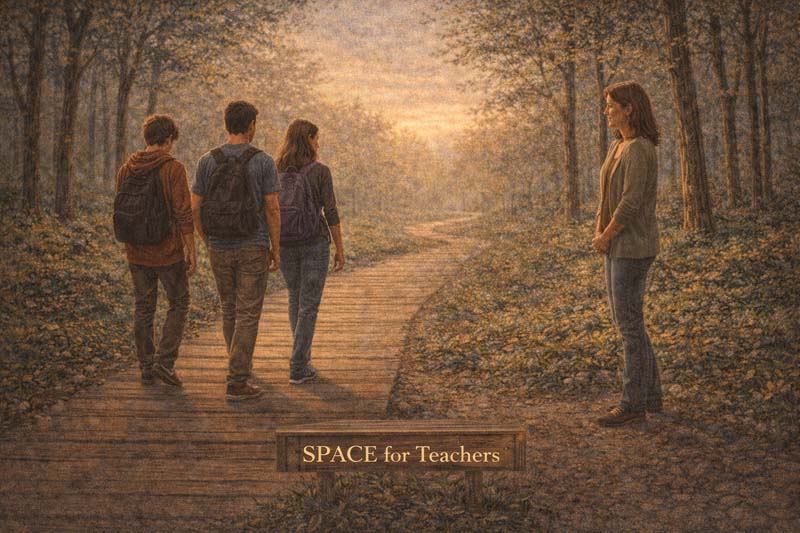
🧑🏫 SPACE for Teachers
Key tension: Care vs learning
Primary risk: Over-accommodating in ways that reduce growth, independence, or fairness
How SPACE looks for teachers
S — Slow the Classroom Energy
Your nervous system sets the tempo of the room.
A calm, predictable pace helps students move from emotional reactivity back into learning mode.
P — Presence Without Power Struggles
Connection comes before compliance.
You do not need to win the moment to teach the lesson.
Regulation first; learning follows.
A — Acknowledge the Experience
Name the difficulty without shaming the student.
“You’re finding this hard” opens the door that “You’re being disruptive” slams shut.
Acknowledgement restores dignity and reduces escalation.
C — Contain with Predictable Structure
Clear routines, boundaries, and expectations are regulating.
Consistency is not rigidity — it is safety.
Structure allows students to practise self-control within a held environment.
E — Encourage Skill-Building, Not Dependence
Support strategies, scaffolds, and reflection.
Avoid doing for what the student needs to learn to do with support.
The goal is growing capacity, not removing challenge.
Teacher reframe:
Calm classrooms are built through steadiness, not control.
Support and high expectations can coexist.

🎓 SPACE for Lecturers
Key tension: Support vs autonomy
Primary risk: Rescuing in ways that undermine independence or responsibility
How SPACE looks for lecturers
S — Slow the Interaction, Not the Student
Your calm presence helps de-escalate urgency without taking over.
Adult learners benefit from steadiness, not supervision.
P — Presence Without Parenting
You are an educator, not a carer.
Being present does not mean managing emotions or fixing outcomes.
Respectful availability supports autonomy.
A — Acknowledge Without Infantilising
Recognise challenge without diminishing agency.
“This sounds overwhelming” validates experience without lowering expectations.
C — Contain with Clear Academic Boundaries
Clarity around roles, deadlines, and processes is regulating.
Boundaries protect fairness — for the student and for others.
E — Encourage Self-Directed Skill Use
Point students toward strategies, services, and reflection.
Support ownership of learning rather than stepping in to compensate.
Lecturer reframe:
Support does not require rescuing.
Respect, clarity, and autonomy are regulating for adult learners.
A quiet unifying truth. Teachers hold structure so skills can grow. Lecturers hold steadiness so autonomy can emerge.
Same SPACE. Different developmental needs. Same respect.
How the Pieces Fit Together
People often ask:
“What am I meant to do when they’re overwhelmed — and how does that connect to what they’re learning?”
This crosswalk answers that question. It shows how:
CALM and RISE are self-regulation skills taught in FLOURISH
SPACE is the co-regulation companion taught in HEART
Each step in SPACE helps make it easier for the person with ADHD to access the CALM and RISE skills they are learning — especially under stress
Think of it as inside work and outside support meeting in the middle.
Mon - Fri: 8AM - 6PM
Sat - Sun: Variable
Brisbane North Medical Specialists,
15 Dallas Parade, Keperra, QLD 4054
(07) 5221 3489
reception@bnms.com.au